
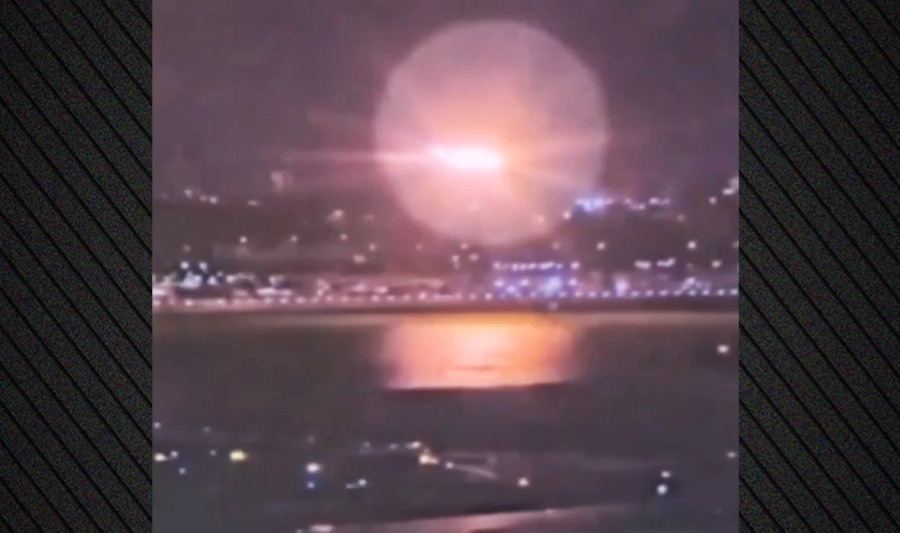
A new video has been released of the moment an American Airlines civilian plane collided with a military helicopter over Washington's Ronald Reagan Airport.
According to foreign media, after the collision, the plane with 64 people on board fell into the Potomac River. At the time of the accident, the control tower was understaffed.
Exclusive dash-cam video obtained by The Washington Post shows a previously unseen angle of the moment a plane and helicopter collided over the Potomac River on Wednesday night. https://t.co/1VErSdPVDW pic.twitter.com/kTicwRejsz
— The Washington Post (@washingtonpost) January 30, 2025
Unfortunately, there were no survivors from the accident, out of the 64 people who were on board the plane and 3 others on board the helicopter. So in total, 67 people died from the air crash, writes A2 CNN.
Staffing in the air traffic control tower at Ronald Reagan Washington National Airport was not "normal for the time and volume of traffic" Wednesday night, according to a preliminary internal safety report from the U.S. Federal Aviation Administration (FAA).
The controller operating helicopters in the airport area at the time was also giving instructions to planes landing and departing from his runways. These duties are usually assigned to two auditors, not one.
???????? New footage of yesterday's plane and helicopter collision over Washington pic.twitter.com/5RzFgIPurk
— Sprinter Observer (@SprinterObserve) January 31, 2025
This increases the workload for air traffic controllers and can complicate their job. One reason is that controllers may use different radio frequencies to communicate with pilots flying airplanes and pilots flying helicopters. So while the controller is communicating with the helicopter and airplane pilots, they may not be able to hear each other.
According to the FAA report on the fateful evening, helicopter traffic management and aircraft management duties were split between two people from 10 a.m. to 9:30 p.m. at the airport. After 9:30 a.m., these duties are usually combined, provided traffic is light.
However, an air traffic controller judged that the traffic was not "congested" and decided, sometime before 9:30 PM, to allow an air traffic controller to leave earlier than the end of the shift.
This staffing configuration was not "normal for the time of day and traffic volume" and it remains unclear why the supervisor chose to do this on Wednesday evening, writes A2 CNN. (A2 Televizion)
A2 CNN Livestream
MUND TE LEXONI GJITHASHTU


