
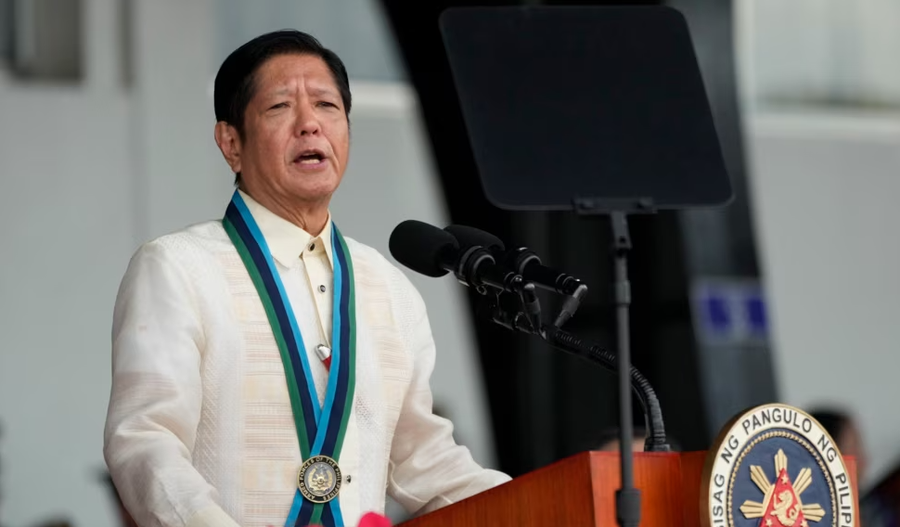
Philippine President Ferdinand Marcos Jr. said Thursday that his country will remove a U.S. missile system from the Philippines if China stops what he called “aggressive and threatening behavior” in the South China Sea.
The US military deployed the Typhoon medium-range missile system to the northern Philippines in April last year to support what traditional allies described as a joint combat readiness exercise.
China has repeatedly demanded that the Philippines give up the missile system, saying it was "provoking a geopolitical confrontation and an arms race."
Asked by reporters about China's criticism of the system, President Marcos said he did not understand the Chinese position because the Philippines does not comment on China's missile system, which "is thousands of times more powerful than the one we have."
"Let's make a deal with China: End the claims to our territory, end the mistreatment of our fishermen and let them earn their living, end the attacks on our boats, end the water cannons and laser attacks on us, and end the aggressive and threatening behavior, and we will return the typhoon missiles," President Marcos told reporters during a visit to Cebu province.
"Stop all the actions you are taking and I will take them back," he said.
Chinese officials have not yet reacted to President Marcos' statements.
The US military's Typhoon missile system, which consists of a launcher and at least 16 standard and Tomahawk land-attack missiles, was repositioned two weeks ago from the northern Philippines to a more strategic area near the capital Manila, in coordination with Philippine defense officials, a senior official told the Associated Press.
The Philippine official, who spoke on condition of anonymity because he was not authorized to discuss sensitive matters publicly, said the US system is now closer to an area where Chinese and Philippine coast guards and marines are increasingly clashing in the South China Sea.
The Tomahawk missiles can travel a distance of over 1,600 kilometers, putting parts of China's territory within their range. The system will remain in the Philippines for an indefinite period, according to the official.
Chinese Foreign Ministry spokeswoman Mao Ning said last week that the Philippines is "creating tensions and hostility in the region and inciting geopolitical confrontation and an arms race" by allowing the deployment of the US missile system on its territory.
"This is an extremely dangerous action and an extremely irresponsible choice," she declared.
Philippine Defense Secretary Gilberto Teodoro rejected China's demand for the return of the missile system, calling it interference in the Philippines' internal affairs.
The United States and the Philippines have consistently condemned China's increasingly aggressive actions to advance its territorial claims in the South China Sea, where hostilities have escalated over the past two years, including ongoing clashes between Chinese and Philippine navies and their ships.
In addition to China and the Philippines, Vietnam, Malaysia, Brunei and Taiwan also have claims to these important sea routes, which are key for transporting goods, but which are also believed to hold large fuel reserves./ VOA (A2 Televizion)
A2 CNN Livestream
MUND TE LEXONI GJITHASHTU


