
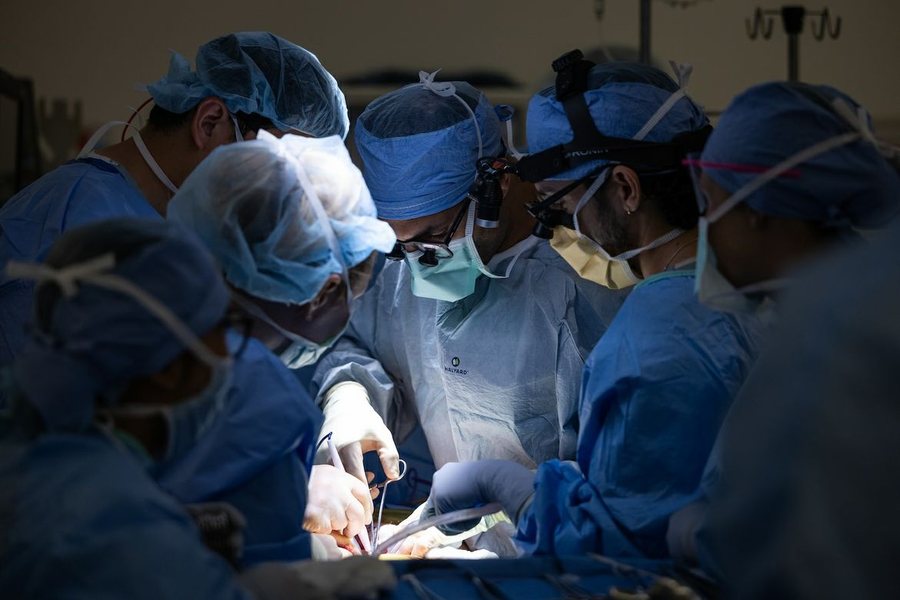
A team of surgeons in California have completed, after four years of work, the first bladder transplant in a living patient, a particularly complex operation that is considered a milestone for medicine. The recipient, a 41-year-old survivor of an aggressive form of urinary tract cancer and condemned to dialysis, is doing well, has recovered kidney function and is able to urinate on his own, although the risks associated with the operation cannot be said to have been overcome.
The transplant recipient, 41-year-old Oscar Larrainzar, a father of four, had previously lost most of his bladder during a tumor removal procedure, leaving the remaining part too small and compromised to function. Both of his kidneys were subsequently removed due to cancer and end-stage kidney disease, and he had been on dialysis for seven years, A2 CNN reports.
While a normal adult bladder, when fully filled, can hold 300-400 milliliters of urine, Larrainzar's bladder can only hold 30 milliliters of urine.
Until now, patients whose bladders had been surgically removed were offered urinary diversion procedures.
This type of surgery creates complications in 80% of cases: among the most common are urinary infections, progressive loss of kidney function, and new digestive problems caused by the reduction of the intestinal tract.

In addition to a new bladder, Larrainzar also received a new kidney, from the same donor. The team first transplanted the kidney and then the bladder, then connected the two organs using a previously studied technique. The surgical procedure took about 8 hours. The medical team's choice to connect some of the bladder's arteries and veins before implanting it made the procedure a little easier.
And the results were immediate. The kidney immediately began producing a large volume of urine, and kidney function, as measured by creatinine levels, a waste product of an energy source used by muscles, improved immediately. He no longer needed dialysis after the surgery, and urine flowed properly into the new bladder. Two days after he was released from the hospital, after the catheter was removed, the patient was able to urinate on his own for the first time in seven years. However, the long-term effects of the surgery are not yet clear, nor how long the man will have to take immunosuppressive drugs, reports A2 CNN.
Bladder transplants have never been attempted before because of the complex vascular structure that feeds the organ, which lies deep in the pelvic area. While these vessels are simply cut to remove the bladder, for example due to a tumor, for bladder donation they must be preserved, which significantly increases the technical difficulty of the operation, A2 CNN reports.
The transplant was performed at the University of California, Los Angeles (UCLA) Medical Center on May 4, by a team led by Nima Nassiri, a surgeon at the center's Urology Institute, and Inderbir Gill, director of the Urology Institute at the University of Southern California.
Before the surgery, the two collaborated for years to develop and then perfect the technique.
Nassiri and Inderbir trained in various roles for years, using robotic and manual techniques, practicing on pigs, cadavers, and patients who had donated their bodies for research, who had no brain activity and were kept alive by machines.
The California team plans to perform bladder transplants on four more patients as part of a clinical trial to assess the capacity of the transplanted bladder and any complications from the surgery, before seeking an expansion of the procedure into a larger clinical study. (A2 Televizion)
A2 CNN Livestream
MUND TE LEXONI GJITHASHTU


