
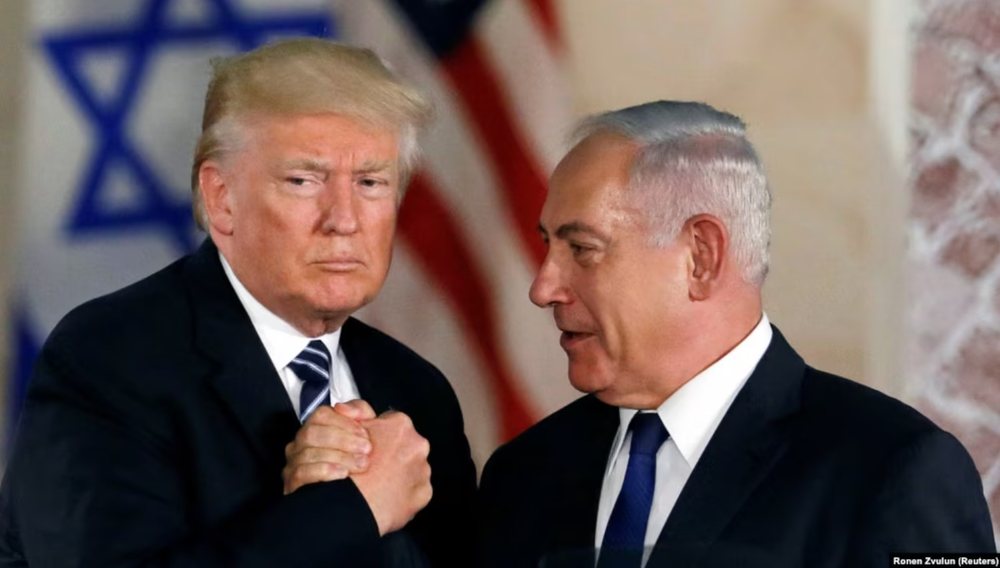
Israeli Prime Minister Benjamin Netanyahu arrives at the White House today as the first guest of US President Donald Trump since his inauguration on January 20.
The visit comes at a critical time for the ceasefire in Gaza and amid ongoing controversy over Trump's idea of removing the Palestinian population from the strip.
At this time, talks should also begin on the second phase of the ceasefire agreement between Israel and Hamas - a group designated a terrorist group by both the US and Israel.
"This is a very significant meeting that, to a large extent, will dictate the trajectory of the entire war, as well as the agreement," Avi Melamed, a former Israeli intelligence officer, tells Radio Free Europe.
Speculation about the course of the meeting is rife. Some analysts say Trump will try to persuade Netanyahu to move the peace process forward and avoid a return to war.
"... so, an attempt to end the situation as soon as possible," says Melamed.
The meeting comes just days after Trump called for Palestinians from Gaza to be relocated to Egypt and Jordan.
The plan to "clean up" the strip, as he said, would mean "they could live, perhaps, in peace."
This suggestion was welcomed by some hard-line politicians in Netanyahu's cabinet, but met with indignation among Arab countries.
"In the Middle East it is seen as an idea that doesn't work, undesirable, illegal," Chris Doyle, director of the Council for Arab-British Understanding, tells Radio Free Europe.
"This has been a red line for Egypt not only during the era of President [Abdel-Fattah] Sisi, but also during the time of [former President Hosni] Mubarak. They would not accept Gaza being thrown into Egypt," Doyle adds.
Several million Palestinians already live in Jordan and tens of thousands more in Egypt. Trump seems to suggest that their dependence on large levels of US military and financial aid will encourage them to compromise.
"We do a lot for them and they will do the same," he said on January 30.
Melamed says that some voices on Arab social media are challenging official positions.
"People say: The Palestinians in Gaza have nowhere to go back to. They have no homes, they have no services," he says, adding that their argument is: "I want to have a future for myself and my children. I want to have a house, not a tent."
Melamed, however, acknowledges that views like this do not constitute a trend.
Doyle, on the other hand, says Trump's comments could be "an overt negotiating tactic, knowing full well that they won't take 1.5 million refugees."
Other Israeli observers are also skeptical of Trump's idea.
Writing for the Haaretz news website, veteran commentator and retired army officer Zvi Bar'el said that Trump's proposal for Gaza could jeopardize the current ceasefire in Gaza.
According to him, this could encourage Hamas not to release the Israeli hostages.
"Releasing all hostages requires Israel not only to end the war, but also to refrain from restarting it and to begin discussing the rehabilitation of Gaza. But if Trump's transfer idea is on the table, the demand to remove it could become Hamas' key condition - which would jeopardize even the continuation of the deal," Bar'el wrote.
Another possible element of the Trump-Netanyahu talks will be Israel's prospect of normalizing relations with Saudi Arabia.
Trump's Middle East envoy, Steve Witkoff, traveled to Israel, via Riyadh, last week.
The agreement would be extremely important, following the Abraham Accords, which established diplomatic relations between Israel, the United Arab Emirates and Bahrain, during Trump's first administration.
But the deaths and destruction that Israel has caused in Gaza, following Hamas attacks on Israel on October 7, 2023, are said to have made this agreement politically difficult for Saudi Arabia.
Furthermore, Riyadh has linked the formalization of ties with Israel to a two-state solution, namely the creation of a Palestinian state in Gaza and the West Bank.
At the weekend, Saudi Arabia signed a joint statement with Egypt, Jordan, Qatar, the United Arab Emirates, the Palestinian Authority and the Arab League, condemning the idea of population transfer. /REL (A2 Televizion)
A2 CNN Livestream
MUND TE LEXONI GJITHASHTU


